
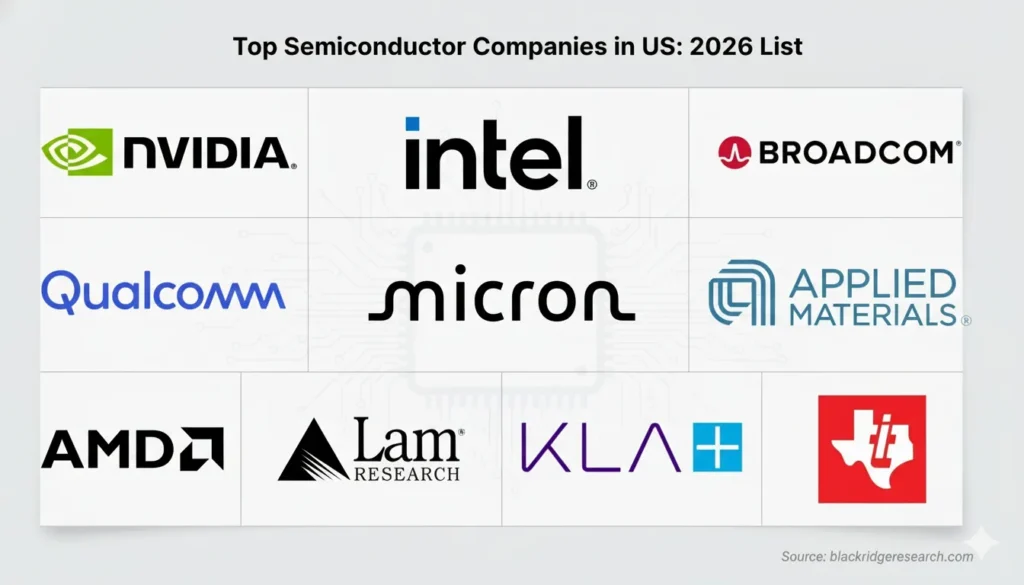
The United States is experiencing a semiconductor renaissance. With the CHIPS Act pouring billions into domestic manufacturing and major players expanding their U.S. footprints, understanding the landscape of US semiconductor companies has never been more important.
Whether you’re an investor, a job seeker, a procurement professional, or simply a tech enthusiast, this guide will walk you through everything you need to know about America’s chip industry.
I have spent weeks researching the current state of US semiconductor companies, speaking with industry insiders and analyzing market data. Here is what I discovered about who is building what, where, and why it matters for the future of American technology.
What Are US Semiconductor Companies and Why Do They Matter?
Semiconductors—also known as chips or integrated circuits—are the brains behind every modern electronic device. From your smartphone to your car to the systems that power the electrical grid, semiconductors make it all work.
US semiconductor companies have historically led the world in chip design and innovation. While much of the actual manufacturing shifted to Asia over the past three decades, America remains home to many of the industry’s most important players.
The U.S. semiconductor market now represents over $250 billion in annual output, making it a cornerstone of the American economy . With the CHIPS Act incentivizing domestic production, US semiconductor companies are building new fabrication facilities (“fabs”) across the country.
The Complete List of Major US Semiconductor Companies
Let me break down the key players in the American semiconductor ecosystem. I have organized them by their primary focus areas.
US Semiconductor Companies: Chip Design (Fabless)
These US semiconductor companies design the chips but outsource the actual manufacturing to foundries like TSMC.
| Company | Headquarters | Known For | Market Position |
|---|---|---|---|
| NVIDIA | Santa Clara, CA | AI chips, gaming GPUs, data center accelerators | World leader in AI semiconductors |
| AMD | Santa Clara, CA | CPUs, GPUs, gaming consoles, server processors | Intel’s primary competitor |
| Qualcomm | San Diego, CA | Smartphone processors, 5G modems | Dominant in mobile chips |
| Intel | Santa Clara, CA | CPUs for PCs and servers, foundry services | America’s largest semiconductor company |
| Broadcom | San Jose, CA | Networking chips, wireless components, infrastructure | Key player in data center connectivity |
| Texas Instruments | Dallas, TX | Analog chips, embedded processors | Leader in industrial and automotive chips |
US Semiconductor Companies: Manufacturing (IDMs and Foundries)
Integrated Device Manufacturers (IDMs) both design and manufacture their own chips.
| Company | Primary U.S. Fab Locations | Specialty |
|---|---|---|
| Intel | Arizona, Oregon, New Mexico, Ohio (coming) | Leading-edge logic chips |
| Texas Instruments | Texas, Utah, Maine | Analog and embedded chips |
| Micron Technology | Idaho, Virginia, New York (planned) | Memory chips (DRAM, NAND) |
| Analog Devices | Massachusetts, Oregon, Washington | Analog, mixed-signal, power management |
| ON Semiconductor | Arizona, Idaho, Maine | Intelligent power and sensing solutions |
| GlobalFoundries | New York, Vermont | Specialized chips for automotive, aerospace, IoT |
US Semiconductor Companies: Equipment and Materials
These US semiconductor companies supply the tools and materials needed to manufacture chips.
| Company | Headquarters | Products |
|---|---|---|
| Applied Materials | Santa Clara, CA | Wafer fabrication equipment, deposition, etch, inspection |
| Lam Research | Fremont, CA | Etch and deposition equipment |
| KLA Corporation | Milpitas, CA | Process control and yield management systems |
| Teradyne | North Reading, MA | Automated test equipment |
| Entegris | Billerica, MA | Contamination control, materials handling |
Foreign Semiconductor Companies with Major U.S. Operations
Many non-U.S. companies have established significant American footprints.
| Company | Home Country | U.S. Presence |
|---|---|---|
| TSMC | Taiwan | Fab under construction in Phoenix, AZ (2025 completion) |
| Samsung | South Korea | Fab in Austin, TX; new fab in Taylor, TX |
| ASML | Netherlands | Headquarters in Wilton, CT; R&D in San Diego |
| Infineon | Germany | Manufacturing in Austin, TX |
The CHIPS Act: How It Is Reshaping US Semiconductor Companies
The CHIPS and Science Act of 2022 allocated $52 billion to revitalize American semiconductor manufacturing. Here is how US semiconductor companies are benefiting:
| Company | CHIPS Act Funding (Est.) | Project |
|---|---|---|
| Intel | $8.5 billion | Expansion in Arizona, Ohio, New Mexico, Oregon |
| TSMC | $6.6 billion | Phoenix, AZ fabs |
| Samsung | $6.4 billion | Taylor, TX fab cluster |
| Micron | $6.1 billion | Boise, ID and Syracuse, NY |
| GlobalFoundries | $1.5 billion | Malta, NY and Essex Junction, VT |
What this means for you: The CHIPS Act is expected to create over 100,000 construction and manufacturing jobs across the United States by 2030. For job seekers, this is the best time in decades to enter the semiconductor industry.
Regional Clusters: Where US Semiconductor Companies Are Located
Different regions of the country specialize in different aspects of the semiconductor supply chain.
Arizona: The New Silicon Desert
Arizona has become a hotspot for US semiconductor companies and international firms building domestic capacity.
Major players in Arizona:
- Intel: Multiple fabs in Chandler
- TSMC: Two fabs under construction in Phoenix (scheduled for production in 2025)
- ON Semiconductor: Facilities in Phoenix
- NXP Semiconductors: Operations in Chandler
Why Arizona? The state offers business-friendly policies, available land, and access to water rights negotiated decades ago.
Texas: The Original Chip Hub
Texas has been home to US semiconductor companies for over 50 years.
Major players in Texas:
- Texas Instruments: Headquarters and multiple fabs in Dallas
- Samsung: Large fab in Austin, new fab in Taylor
- NXP: Austin operations
- Infineon: Austin manufacturing
Oregon’s Silicon Forest
The Portland area, particularly Hillsboro, hosts a dense cluster of semiconductor activity.
Major players in Oregon:
- Intel: Massive campus in Hillsboro (the company’s largest R&D site)
- Analog Devices: Beaverton operations
- Microchip Technology: Gresham fab
- Jireh Semiconductor: Hillsboro
New York’s Tech Corridor
Upstate New York has emerged as a serious contender for semiconductor investment.
Major players in New York:
- GlobalFoundries: Large fab in Malta (Saratoga County)
- Micron: Announced $100 billion investment in Syracuse area
- Wolfspeed: Silicon carbide fab in Utica
- ON Semiconductor: East Fishkill facility
Employment at US Semiconductor Companies: What Job Seekers Need to Know
If you are searching for jobs at US semiconductor companies, here is what the current market looks like.
Most In-Demand Roles (2026)
| Role | Average Salary (US) | Education Required |
|---|---|---|
| Process Engineer | $90,000 – $130,000 | Bachelor’s in Chemical/Electrical Engineering |
| Equipment Technician | $55,000 – $85,000 | Associate degree or military training |
| Quality Control Specialist | $60,000 – $90,000 | Bachelor’s in Engineering or Sciences |
| Facilities Engineer | $85,000 – $120,000 | Bachelor’s in Mechanical/Chemical Engineering |
| Yield Analysis Engineer | $95,000 – $140,000 | Master’s preferred |
| Semiconductor Physicist | $110,000 – $160,000 | PhD in Physics or Materials Science |
How to Find Jobs at US Semiconductor Companies
Based on my research, here are the most effective job search strategies:
- Apply directly through company career pages. Most US semiconductor companies have robust internal recruiting teams.
- Target contract-to-hire positions. Many technicians and entry-level engineers start as contractors through staffing agencies like Aerotek or Kelly Services.
- Leverage military experience. Semiconductor companies actively recruit veterans with electronics training.
- Get certified. Community colleges in semiconductor hubs (Phoenix, Austin, Portland, Albany) offer specialized training programs.
Pro tip: When searching for jobs at US semiconductor companies, avoid relying solely on keywords like “TSMC, Arizona, career” on general B2B platforms. Many listings on sites like Alibaba that tag “TSMC” are not affiliated with the actual semiconductor manufacturer—they are often Chinese suppliers using the term for SEO visibility . Always verify job postings through official company websites.
Investing in US Semiconductor Companies: A Beginner’s Guide
For investors looking at US semiconductor companies, here is what you need to know.
Publicly Traded US Semiconductor Companies
| Company | Ticker | Sector Focus | Risk Level |
|---|---|---|---|
| NVIDIA | NVDA | AI, Gaming, Data Center | High (volatile growth stock) |
| Intel | INTC | CPUs, Foundry, AI | Medium (turnaround story) |
| AMD | AMD | CPUs, GPUs, AI | High |
| Texas Instruments | TXN | Analog, Embedded | Low-Medium (stable dividend) |
| Micron | MU | Memory | Medium-High (cyclical) |
| Broadcom | AVGO | Networking, Infrastructure | Medium |
| Applied Materials | AMAT | Equipment | Medium |
| Lam Research | LRCX | Etch, Deposition Equipment | Medium |
| KLA Corporation | KLAC | Process Control | Medium |
| ON Semiconductor | ON | Power, Sensing | Medium |
Key Trends Driving US Semiconductor Companies in 2026
- AI Accelerator Demand: NVIDIA and AMD are racing to supply chips for AI data centers.
- Domestic Manufacturing Expansion: The CHIPS Act is funding new fabs across the country.
- Automotive Chip Growth: Electric vehicles and advanced driver-assistance systems require more semiconductors per car.
- Aerospace and Defense: US semiconductor companies are critical to national security applications.
Risks to Consider
- Cyclical nature: The semiconductor industry experiences boom-and-bust cycles.
- Geopolitical tensions: US-China trade relations directly impact supply chains.
- High capital requirements: Building new fabs costs $10-20 billion each.
- Talent shortages: The industry faces a shortage of qualified engineers and technicians.
Sourcing from US Semiconductor Companies: A Procurement Guide
If you are a procurement professional looking to source from US semiconductor companies, here is my practical advice.
How to Find Legitimate Suppliers
Based on analysis of B2B platforms, searching for “US semiconductor companies” on general marketplaces often returns misleading results. One search for “TSMC, Arizona” on Alibaba yielded suppliers offering CNC grinding machines, automotive sensors, and even cotton t-shirts—none of which are affiliated with actual semiconductor manufacturing .
Effective sourcing strategies:
| Strategy | How to Execute |
|---|---|
| Use industry-specific directories | SEMI, IPC, and ECA maintain verified supplier lists |
| Check official certifications | Look for ISO 9001, IATF 16949, or AS9100D |
| Request technical documentation | Material certifications, test reports, CAD drawings |
| Verify facility locations | Legitimate US semiconductor companies will provide verifiable addresses |
| Ask for sample batches | Test quality before committing to large orders |
Red Flags to Watch For
- Unrelated product categories: A supplier selling both semiconductors and apparel is likely misusing keywords.
- Suspiciously low prices: Legitimate semiconductor components have stable, market-driven pricing.
- No verifiable facility information: Reputable US semiconductor companies are transparent about their locations.
- Refusal to provide samples: Quality suppliers welcome sample orders.
The Future of US Semiconductor Companies
What can we expect from US semiconductor companies in the coming years?
Short-Term (2026-2027)
- TSMC’s Arizona fabs begin production
- Intel’s Ohio fabs start construction
- Continued AI chip demand driving NVIDIA and AMD growth
- Workforce development programs expand at community colleges
Medium-Term (2028-2030)
- Multiple new U.S. fabs become operational
- Memory production returns to American soil (Micron in New York)
- Advanced packaging facilities come online
- Semiconductor workforce grows by an estimated 50,000+ jobs
Long-Term (2030+)
- Potential for U.S. to regain ~30% of global manufacturing capacity
- Development of next-generation chip technologies (1nm and beyond)
- Integration of AI and automation in semiconductor manufacturing
- Expansion of domestic supply chain for equipment and materials
Final Thoughts: Why US Semiconductor Companies Matter
US semiconductor companies are not just economic engines—they are strategic assets. The chips they design and manufacture power everything from your smartphone to the F-35 fighter jet. After decades of offshoring, America is finally reinvesting in domestic production.
Whether you are:
- A job seeker looking for stable, well-paying work in a growing industry
- An investor seeking exposure to the AI and hardware revolution
- A procurement professional needing reliable domestic supply chains
- A student deciding on a career path
The semiconductor industry offers opportunities that will only expand in the coming years.
The CHIPS Act is working. New fabs are rising from the desert in Arizona to the farmland of Ohio. And US semiconductor companies are once again becoming the envy of the world.
Frequently Asked Questions About US Semiconductor Companies
Q: How many semiconductor companies are in the US?
There are hundreds of US semiconductor companies ranging from giants like Intel and NVIDIA to small fabless design firms. The Semiconductor Industry Association (SIA) represents over 50 major US-based companies.
Q: What is the largest US semiconductor company?
Intel is the largest American semiconductor company by revenue among IDMs (companies that both design and manufacture chips). NVIDIA recently surpassed Intel in market capitalization, making it the most valuable US semiconductor company.
Q: Does the US manufacture its own semiconductors?
Yes, but with limitations. US semiconductor companies like Intel, Texas Instruments, and Micron manufacture chips domestically. However, the most advanced chips (3nm and below) are currently only produced by TSMC in Taiwan. TSMC’s Arizona fab is expected to change this when it begins production.
Q: Which US semiconductor companies pay the highest salaries?
Based on industry data, NVIDIA, AMD, and Intel typically offer the highest compensation packages for engineers. Equipment manufacturers like Applied Materials and Lam Research also pay competitively.
Q: Are US semiconductor companies hiring in 2026?
Yes. With multiple new fabs under construction, US semiconductor companies are actively hiring process engineers, equipment technicians, facilities specialists, and quality control staff. The industry faces a well-documented talent shortage, making this an excellent time to enter the field.
Q: What certifications do US semiconductor companies look for?
Commonly requested certifications include IPC-A-610 (acceptability of electronic assemblies), J-STD-001 (soldering), and ISO 9001 (quality management). Some roles require security clearance for defense-related work.